Compiled by Conor Youhei Hustedde, Communication Specialist Student Assistant
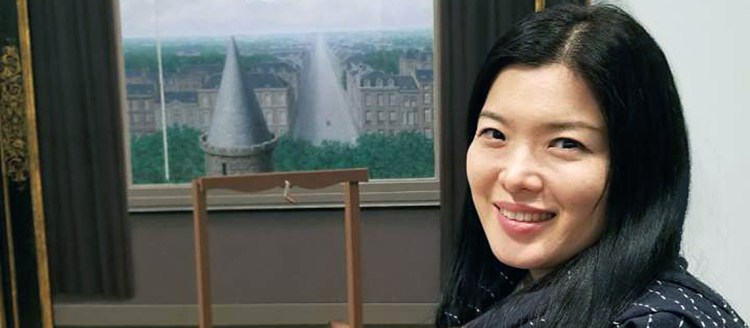
The College of Arts and Humanities is excited to greet Dr. Young Maeng into the Department of Art, Design and Art History. Dr. Maeng was raised in South Korea and has studied and lived in multiple countries, including South Korea, the United States, and the United Kingdom. She earned a B.F.A. in art education, M.F.A.s in fine art painting and Korean painting, and a practice-based Ph.D. in contemporary arts. Her Ph.D. project was in documentation art, exploring the boundaries between film and painting and developing an original approach to the presentation of the process. Welcome, Dr. Maeng!
Tell me a little about yourself. Where were you born? Where did you grow up? What schools/universities did you attend?
I am an artist-researcher in contemporary arts, born in South Korea. I have studied and lived in multiple countries, including Korea, the USA and the UK. I earned a practice-based Ph.D. in contemporary arts at Lancaster University, UK. Additionally, I received an M.F.A. in fine art painting from the San Francisco Art Institute. Prior to that, I earned an MFA in Korean painting and a B.F.A. in art education at Kyung Hee University in South Korea.
What do you love about art?
I grew up in a very solitary countryside in Korea. During my childhood, my parents operated a cattle farm, and I spent a lot of time alone, reading children’s books and painting and drawing everything around me. Since then, painting and drawing have become essential parts of my life, shaping how I love my life and the world around me. Creating art is a way for me to encounter the world with pure sensations, and it allows me to experience and suggest a new perspective, free from preconceived fixed ideas, clichés, and presuppositions.
Where do you find your inspiration?
I find inspiration not typically from my own experiences but believe that creative energy comes from sources external to myself. I am intrigued by different people and unfamiliar events around me. I use painting and philosophical studies to research and reinvent them, transforming them into artistic creations that can evoke positive changes in people’s minds and societies. In my recent painting practice, I am exploring the art philosophical meaning of E.D.I. (equity, diversity and inclusion) in relation to ethical issues and invisible violences surrounding human-AI companion robot interactions.
What are you most looking forward to teaching at Fresno State?
I am thrilled about the prospect of teaching studio practice in painting and drawing at Fresno State because my passion lies in educating future artists rather than future art teachers. Previously, I taught in a renowned teacher education program in South Korea, where my focus was on art history, aesthetics and art education theory and practice. While I thoroughly enjoyed teaching theory, I am eager to share my extensive artistic skills with fine art students to help them succeed in their artistic careers. I am confident that my skills and knowledge in contemporary art will contribute to building a robust fine art department at Fresno State, producing not only brilliant artists but also community leaders and creative entrepreneurs.
What are your teaching specialties? How did you become involved with those areas?
Thanks to my Ph.D. research in Korean painting and Gilles Deleuze’s philosophy, I have specialized in Gilles Deleuze’s aesthetics of sensation and Korean bunche painting. Additionally, I teach various disciplines in art. In terms of practice, I instruct Western and Asian painting and drawing, expanded painting practice, video and installation. On the theoretical side, I cover modernism and post-modernism art history, Korean and Asian art history, Western and Asian aesthetics as well as art education theories and practices.
Why are your personal endeavors into documentation art important, both for you personally and for our societies as a whole?
The documentation art project is my art practice-based Ph.D. project, which explores the boundaries between film and painting and develops an original approach to the presentation of the process. This practice makes the invisible work of painting visible and reveals the normally hidden process, imperceptible when audiences view only the final painting. “Documentation art” is based on the Bunche painting technique, a Korean painting method using powder pigments mixed with water glue on Korean paper in multiple layers. This project is crucial for both me and society as a whole because it delves into how we perceive truth as changing, rather than a fixed statute of things. It is related to the French philosopher Gilles Deleuze’s process ontology, transcendental aesthetics of sensation and Henri Bergson’s theory of memory. As Deleuze writes, we are not defined by fixed ideas and selves but are set in motion in time with endless new changes.
How do you hope your background will elevate the Art, Design and Art History Department’s offerings at Fresno State?
I have a background in both Korean and Western painting, along with studies in aesthetics and philosophy that encompass Western and Asian art. My experience in art education teaching and studio art instruction will bring substantial pedagogic value to the Department of Art, Design and Art History.
As a new instructor who will be teaching painting and drawing, what’s your biggest wish for undergraduates as they learn to explore the intersections of cultures, identities, and geographies over time?
I strongly believe that cultivating understanding and interest in diverse cultures is crucial for undergraduate art students. This approach helps them evolve into well-rounded, informed art practitioners capable of contributing to positive changes in society and the world. Consequently, I plan to introduce courses that de-colonize the curriculum, aiming to broaden students’ perspectives and deepen their understanding of both themselves and the world.
What is a book you think everyone should read?
Pachinko by Lee Min Jin is an epic historical fiction novel that traces the journey of a Korean family immigrating to Japan. The book was a thoughtful gift from my German artist friend, who thoroughly enjoyed the story.
What are your fall 2023 office hours?
My office is situated in CA 223 at the Conley Art Building, and I hold office hours from 5:00 p.m. to 6:00 p.m. on Mondays, Tuesdays and Thursdays. I welcome collaborative research across various disciplines, including computer science, social science, philosophy, dance and music.
To explore more of Dr. Maeng’s art, visit her website, which showcases her different pieces, workshops, and more: www.hyeyoungmaeng.com
 The College of Arts and Humanities at Fresno State