
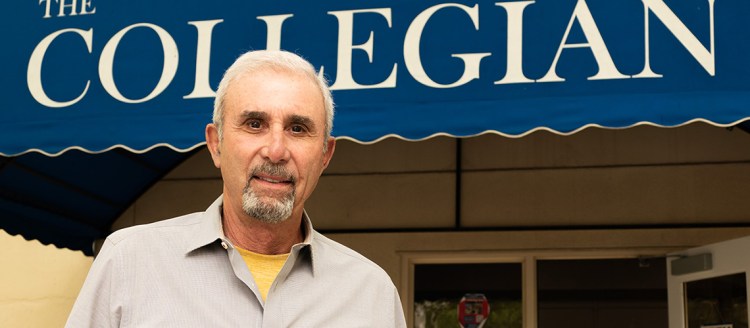
“This is the story of how I lost my girlfriend,” Dennis Morgigno quipped. “I was up at 5 a.m. to work on the Collegian and working till 10 p.m. Three nights a week at the station and still not making enough money to quit selling shoes on the weekends.”
As a Fresno State journalism student, Morgigno was busy. He served as the editor of “Insight,” a weekly newspaper published by the journalism department, and later became the editor of the Daily Collegian, Fresno State’s independent school newspaper.
“It was working at a real newspaper. We put out five papers a week, and we had to put one out every day, and it gave you a sense of what it was like to make those kinds of choices you had to make to do that,” Morgigno said.
His news writing class professor was Bob Long, who was also an anchor and news director at KMJ-TV, channel 24 in Fresno (now KSEE-24). Noticing Morgigno’s writing speed, Long offered him a job as a news writer, a job he did while working at the Daily Collegian and studying at Fresno State.
Morgigno said scholarships helped him immensely while he was a student.
“[Scholarships] definitely allowed me to focus more on my studies,” he said. “Had it not been for those scholarships…I’d have been working outside of school a lot more and not had the opportunity to be the editor of the Collegian, be the editor of Insight, to write the spec story that got me the internship at the Merced Sun-Star.”
“Dennis talks about how scholarships helped him when he was a student at Fresno State. Now he’s paying it forward in the most impactful way,” said Faith Sidlow, chair of the Department of Media, Communications and Journalism at Fresno State.
Legendary faculty members, such as Roger Tatarian, Dayle Molen and Jim Tucker, cared about journalism and their students, and, Morgigno says, laid a foundation and gave him role models to look up to. He was able to take that educational base and apply it to hands-on experience at the Insight and Daily Collegian.
“This place is very special to me because it created the foundation for me to make the mistakes that I needed to make before I went and got a job. And I didn’t make those mistakes there. And I was very successful in my career.”
Born in Brooklyn, New York, Morgigno’s parents moved to Fresno, where his mother is from, when he was a young child. He went to Fresno High School and in 1970, enrolled at Fresno State, initially as an English major, but changed his major to journalism.
“The reason I chose journalism is because I wanted to find a way to write for a living,” Morgigno said. “What I discovered…was that [Fresno State] had one of the best journalism schools in the entire state.”
In January 1975, Morgigno graduated from Fresno State with a degree in journalism. By the time he graduated, he had moved from a writer to producer, then weekend anchor at Channel 24. By 1978, he was anchoring all three Monday through Friday evening newscasts.
Prior to May 1979, McClatchy Newspapers owned the Fresno Bee, KMJ-TV Channel 24 and two radio stations, KMJ AM and FM. Throughout the mid and late 1970s, McClatchy was challenged for its broadcast license due to media dominance in the market. While McClatchy initially beat an antitrust case, the challenge to their broadcast license from the San Joaquin Communications Corporation remained. After several years, in 1979, McClatchy agreed to sell the station to San Joaquin Communications because continuing the fight would impose “an unreasonable burden of uncertainty on the community, the station and its employees and its advertisers,” according to C.K. McClatchy.
After his news director at Channel 24 advised him to get another job before the new owners took over, Morgigno found a position as a news reporter and anchor at Channel 7/39, the NBC station in San Diego. Within a few years, he was one of the two main anchors at the station until late 1987, when new owners did not renew the anchors’ contracts.
“I first met Dennis when I was his intern at Channel 7/39 in San Diego. He taught me how to write quickly, accurately, and efficiently, skills that became the foundation of my own journalism career,” said Sidlow.
Between jobs, Morgigno worked with a former colleague to build and run the 1988 America’s Cup sailing race media center in San Diego.
After a brief stint working at the FOX television station in Los Angeles, Morgigno returned to San Diego to run media centers for the 1991 World Championship sailing race and the 1992 America’s Cup. He also got a freelance gig working at the 1992 Barcelona Olympics, creating videos to send to the athletes’ hometown television stations.
When all the freelance work dried up, Morgigno reluctantly took a position for two years at KUSI, an independent television station in San Diego.
“After doing that for two years, I said, ‘You know what? I don’t like the state of the business anymore, and I don’t like what you have to do to remain in the business anymore. So, I’m out.’”
Looking for a new direction, Morgigno met the new general manager at the COX Communications, who was interested in creating a local channel and developing original programming. Excited about creating something new, in 1995, Morgigno began working for the cable television business.
An opportunity to test their concepts came when the 1996 Republican Convention was held in San Diego. Setting up a temporary channel only available in the convention center hotel, they presented programming highlighting the community and the region.
“It was an overwhelming success,” said Morgigno.
As a result, COX moved forward with creating Channel 4 San Diego, a channel only available with a cable subscription. As they were pulling everything together, Morgigno realized that the television station airing the San Diego Padres games was struggling financially. Seeing an opportunity, he secured the broadcast rights and subsequently built the station around local sports programming, including the San Diego State Aztecs and other college and high school sports coverage.
Looking to be more than just a sports station, Morgigno and his team developed several news magazine programs, including the award-winning “San Diego Insider” that he hosted.
“The news magazines allowed us to do the kind of journalism that the local broadcast stations had really abandoned because the staffs kept getting smaller and smaller,” said Morgigno. “We produced some very high-quality stuff because I hired journalists I used to work with.”
In 2003, Morgigno received the Harold Keen Award for Career Achievement in Journalism from the San Diego Press Club and the Silver Circle of the National Academy of Television Arts and Sciences, Pacific Chapter, recognizing his contributions to San Diego Television for over 25 years.
“It was a great honor because Harold Keen was one of the most respected journalists ever in San Diego,” Morgigno said.
After the 2011 San Diego Padres season, COX lost the contract to televise the games. In 2013, Channel 4 San Diego shut down. Morgigno stayed with COX Communications as the Director of Communications until he retired in 2014.
“The most impactful thing that journalism had on my life was that I got to meet so many interesting people and hear so many stories about the world through them. I’d go to work every day, and I never knew who I was going to meet and what I was going to hear. And that kept the flame going for all those years.”
Now retired, Morgigno and his wife, Jennifer Stone, actively support Fresno State and San Diego State through donations and scholarships.
“My wife is a San Diego State graduate, and so we give to both schools because we firmly believe in giving people the opportunity to get that education. It’s informed our lives,” Morgigno said. “When you give somebody that opportunity and they flourish, for us, there’s no better feeling.”
“This scholarship helped me further my education, and it is because of Dennis’ generosity that I am able to pursue a higher education,” said Chelsi Braudrick, Dennis Morgigno Scholarship recipient.
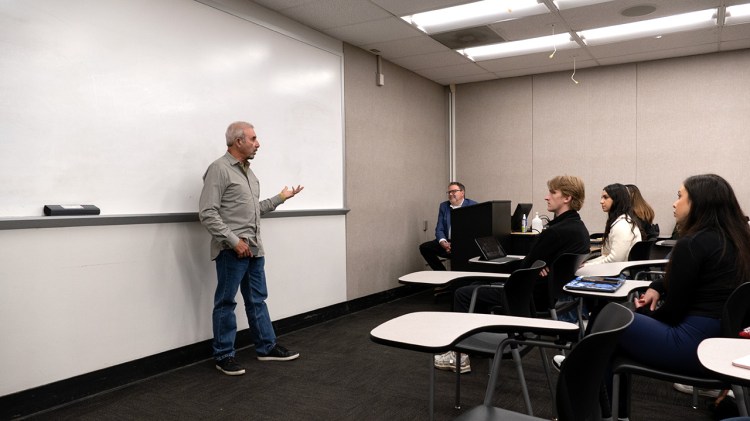
In April, Morgigno stood in front of a classroom of student journalists at Fresno State and talked with them about his career and imparting his advice.
“Make sure that whatever you’re doing, you maintain your integrity and credibility through the integrity of your work. Source your stories. Don’t listen to people who say, ‘Well, the news is biased.’ We’re all biased about something. Your job as a journalist is to recognize your bias and make sure it doesn’t appear in your story.”
“Dennis’s ongoing connection to the department is truly inspiring,” said Sidlow. “When accomplished alumni like Dennis return to share their experience, time, and support, it creates a powerful sense of continuity for our students. It helps them see what’s possible and reinforces the value of the education they’re receiving. Dennis brings both generosity and authenticity. His presence reminds our students that the path from Fresno State to a successful career is real and achievable.”
So far, two Fresno State students have directly benefited from the Dennis Morgigno Scholarship for journalism students, and a third student has already been chosen for next year. In addition to the scholarship, Morgigno donated to help upgrade the failing video switchboard in the Fresno State Focus television studio.
 The College of Arts and Humanities at Fresno State