By Jefferson Beavers, communication specialist, Department of English
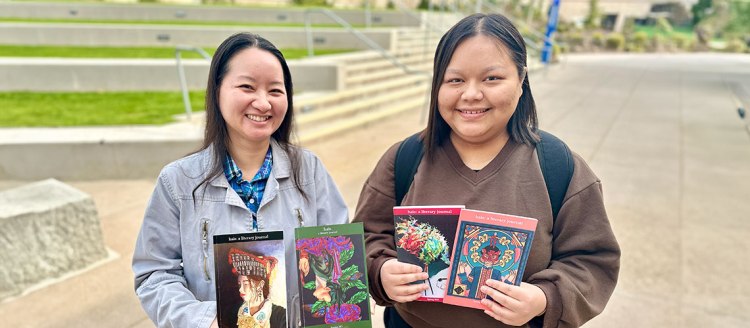
Photo: Hmong American Ink and Stories club co-founder Yia Lee, left, and current president Phoua Lee with copies of the first four issues of “hais: a literary journal.”
When Yia Lee walked onto Fresno State’s campus in the fall of 2018 as a graduate student in the university’s Master of Fine Arts program in creative writing, she, like many other first-time graduate students, didn’t know what to expect.
Lee is Hmong American. She is also a fiction writer. And even though the UC Davis grad had workshopped a couple short stories with the Hmong American Writers’ Circle, a community group founded in 2004 by Fresno State alumnus Burlee Vang, she didn’t have a lot of models for what a writing life could look like.
“Before that time, I always felt alone as a writer,” Lee said. “Especially as a Hmong writer, where not a lot of people I knew were writers. So it was very lonely. And I thought: Was it a weird thing for me to like writing?”
But then Lee met fellow MFA students Jer Xiong and Nou Her — also both Hmong writers — and she immediately felt a new sense of community.
“We thought, hey, we should make a group, we should do something!” Lee said. “We should have workshops, we should make a literary journal, we should promote Hmong and Asian American literature.”
So the trio co-founded the Hmong American Ink and Stories club in the fall of 2019. The club’s acronym, HAIS, is pronounced “hi” and was intentionally chosen by the students because it also forms a word in Hmong language — “hais,” which means to say, to speak, to vocalize.
With support from Fresno State’s Instructionally Related Activities fund, the club published its first issue of “hais: a literary journal,” in spring 2020, providing a platform to showcase writing and art from Hmong, Asian American, and other historically marginalized voices.
The club’s fifth-anniversary issue of “hais: a literary journal” will be released at 6:30 p.m. on Friday, May 10, inside the Grosse Industrial Technology Building (IT 101) on campus. Admission is free and open to the public, and the event will begin with a light reception. [See event details.]
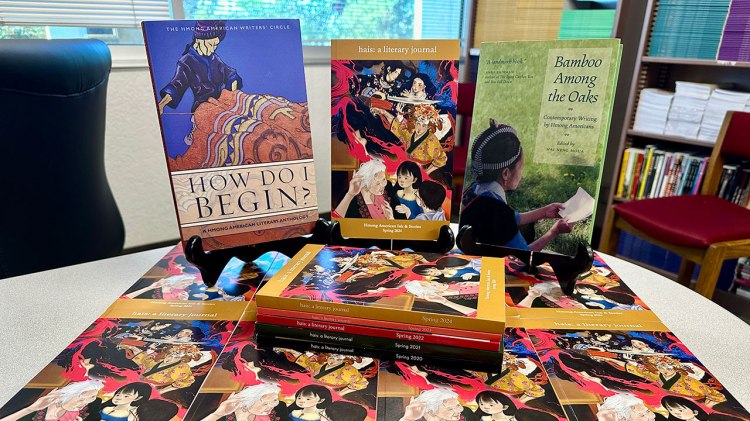
According to author and filmmaker Burlee Vang, in his foreword to “How Do I Begin? A Hmong American Literary Anthology,” published by Heyday Books in 2011, writers of Hmong descent have faced challenges finding their place in literature. Their written language was long ago suppressed and lost, so storytelling persisted in the form of oral traditions.
“Although creative expression within Hmong history and culture is evident in our oral stories, oral poetry, textile art and the playing of various bamboo instruments — what I would categorize as heritage art forms — one will quickly discover that, even in this category, there are no novels, plays, or collections of poems, essays or short stories,” Vang wrote.
“There is no account of Hmong life preserved in writing by a Hmong hand passed down through the centuries.”
Some historians, Vang wrote, say the Hmong language was believed to be lost from forced assimilation under Imperial China thousands of years ago, and that Hmong women disguised the characters of that writing system as clothing embroidery, known as paj ntaub. But the meaning of these symbols became indecipherable.
In the 1950s and ’60s, a century after their migration out of China and into the mountainous regions of Southeast Asia, several writing systems were developed for the Hmong dialect, Vang wrote. Then in the late 1970s through early ’90s, hundreds of thousands of Hmong who had been covertly recruited and trained by the CIA to repel Communist forces in the Secret War in Laos began resettling in the United States.
“It is with the adoption of the English language that Hmong Americans are now witnessing the early stages of a literary tradition,” Vang wrote more than a decade ago. “And like the rest of Western society, we have begun to emphasize the written word.”
The earliest published books of contemporary Hmong literature came in 2002, with Merced writer Pos L. Moua’s poetry chapbook, “Where the Torches are Burning,” and the groundbreaking anthology “Bamboo Among the Oaks: Contemporary Writing by Hmong Americans,” edited in Minnesota by the author Mai Neng Moua, who also founded the influential Hmong literary magazine Paj Ntaub Voice in the 1990s.
The “How Do I Begin?” anthology followed in 2011, edited in California by the Hmong American Writers’ Circle (HAWC), which included Burlee Vang, Soul Choj Vang, Andre Yang, and Anthony Cody, all now Fresno State alumni authors. The group also included Mai Der Vang, now an acclaimed author and Fresno State assistant professor who serves as the HAIS faculty adviser.
In the 13 years since, the number of canonized Hmong authors continues to slowly increase. And in the past five years, Fresno State’s “hais: a literary journal” has become a new space, according to the club’s website, that encourages writers “to become active participants in documenting themselves and their stories in a system that has historically left them behind.”
The journal is, to the club’s knowledge, the only book of its kind to be regularly published by a university anywhere.

Now a Fresno State MFA alumna, Yia Lee currently teaches writing and literature courses as a lecturer for the English Department.
Lee published one of her earliest short stories in the “How Do I Begin?” anthology — “Broken Chords,” a tale of high school friends navigating music, family, and their soon-to-be adult lives — and she credits the Hmong American Writers’ Circle members for teaching her early on about the value of a close-knit writing community, an instrumental lesson when she and her peers co-founded the Hmong American Ink and Stories club.
“Before HAWC, I was really young,” she said. “I was like, I love reading, I love writing, but I don’t know what to do with that, exactly. What I took from HAWC into HAIS was: We build community. We want to meet people, [do] the workshopping, and talk about writing and reading.”
Lee said feedback on “hais: a literary journal” has been encouraging from the start. Submitters have expressed gratitude to the club for the opportunity to be included in such a publication, and submissions continue to come in each year, not just from Central California but from all over the nation and the world.
The club’s current president, Phoua Lee, is a first-year graduate student studying fiction writing in the MFA program. As a Fresno State freshman, she published her first poem, “All That Glitters,” in the inaugural 2020 issue of “hais: a literary journal”.
Here’s a few lines:
You birthed me in a world unfamiliar to us both,
Every summer we watched your amaranth’s growth,
Taught me the way of paj ntaub and my strings they twirled,
Not as graceful as your thread that swirled
Now, four years later, Phoua Lee has become the book’s top editor and the club’s lead organizer.
“I feel like I’ve always grown alongside HAIS,” she said. “Our literary genesis intersects.”
Phoua Lee said getting published as an 18-year-old aspiring writer opened up a new set of questions about writing and publishing. Witnessing her Hmong writer predecessors, she knew she could fit into the publishing space. But how would she be welcomed? What were the rules for her? How would people evaluate and judge her work?
“For me, “hais: a literary journal” really answered those questions, because it was kind of an entry tool that allowed me to get started, and it was low stakes,” she said. “So using the knowledge that I gained from this process, I was then able to publish in larger literary journals. This is one subtle way in which HAIS really prepares sprouting young writers for the larger publishing world.”
Another aspect that working on the journal has revealed: What is “Hmong writing” anyway? Phoua Lee said she has learned to check herself when unconsciously exoticising some aspect of Hmong or Asian American culture in her own works.
With the help of club members past and present, she said she finds herself thinking more and more about how to integrate Hmongness into the everyday topics she wants to write about.
“My writing right now is focusing on a lot of supernatural and mythological elements around the Hmong culture,” Phoua Lee said. “And I like to weave in some queer themes with that too.”
Or, to put it another way: Consider how the Burlee Vang poem “To Live in the Zombie Apocalypse” could illustrate how one Hmong writer can make a scene that could, at once, be a dispatch from a collective Hmong refugee memory, a snapshot from an unforgiving new homeland, and also a kind of zombie valentine:
In darkness,
we learn to read
what moves along the horizon,
across the periphery of a gun scope—
the flicker of shadows,
the rustling of trash in the body
of cities long emptied.
Yia Lee said: “That could be what a Hmong poem is, you know? It’s like storytelling passed down from my parents, but also what the modern Hmong storyteller would be like. It’s exciting to see what other people have come up with and what I could come up with, too.”
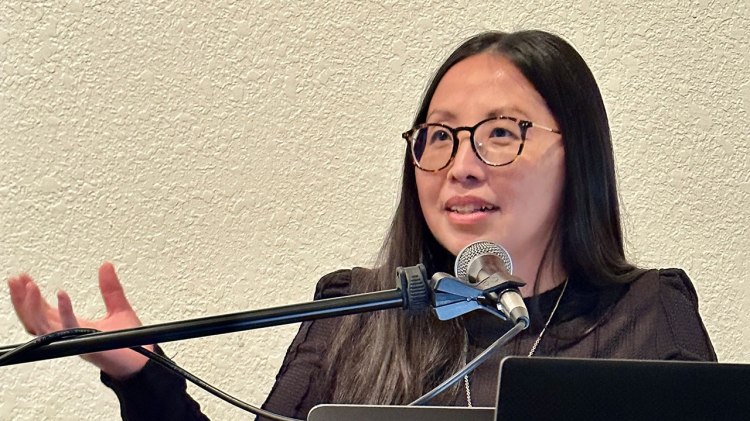
In addition to the growing community of writers that HAIS students have built, another constant during the club’s first five years has been the mentorship of their faculty adviser, the scholar and educator Mai Der Vang.
Winner of the Walt Whitman Award, winner of an American Book Award, and a finalist for the Pulitzer Prize, Mai Der Vang was recently named a Guggenheim Fellow. At Fresno State, she received the university’s 2021 Extraordinary Teaching in Extraordinary Times Award for supporting student success.
Phoua Lee said she remembers crying when first reading the opening poem in Mai Der Vang’s debut book, “Afterland.”
From the poem “Another Heaven,” here’s the opening line:
I am but atoms
Of old passenger
Bereaved to my cloistered bones.
Phoua Lee said her club adviser has inspired a lot of confidence in her as a student, writer, thinker, learner, and leader.
“Just being in Mai Der’s presence all the time, she has a certain confidence and determination that is contagious,” Phoua Lee said. “She’s very sure about herself, about what she wants to do. And so working with someone like that, it makes you sure of yourself. Where you’re going, what you have to get done. It’s really just growth all the time.”
Mai Der Vang said the most rewarding part of serving as HAIS adviser has been seeing the journal published each year by an evolving group of dedicated student editors who work hard through the editorial and production process to make the book a reality.
“They learn new skills that contribute to the literary health of our community while nurturing their own path as aspiring writers and editors,” she said. “I’m encouraged by their enthusiasm, their ambition, and their understanding for why HAIS as a journal and organization exists, and this is what keeps me going.”
Mai Der Vang said the journal — which is open to everyone, Hmong and non-Hmong — has become a special home for the work of emerging Hmong writers and artists. Fresno State’s English Department continues to see a small but steady increase in the number of Hmong American students pursuing both undergraduate and graduate studies in creative writing and literature, some of whom were initially published in “hais: a literary journal.”
“I hope for us to keep publishing while reaching more and new audiences,” she said. “I hope for our journal to connect with Hmong youth who may one day find themselves studying creative writing, here or elsewhere.”
 The College of Arts and Humanities at Fresno State
A great story! Kudos to all doing the groundwork!
LikeLike