By Jefferson Beavers, communication specialist, Department of English
With $2,905 in initial gifts from 39 students, faculty, staff, alumni, and community friends — most of those coming during Fresno State’s annual Day of Giving campaign — the English Department successfully established the new English Department Scholarship fund in 2022.
The English Department Scholarship is a general scholarship intended to support majors from all the department’s programs. The scholarship is set up to receive one-time or recurring gifts, with the intention of awarding those funds immediately to students in the following academic year.
For the scholarship’s first year, the department faculty selected four outstanding scholars. Each of the four inaugural awards was given in honor of an emeriti faculty.
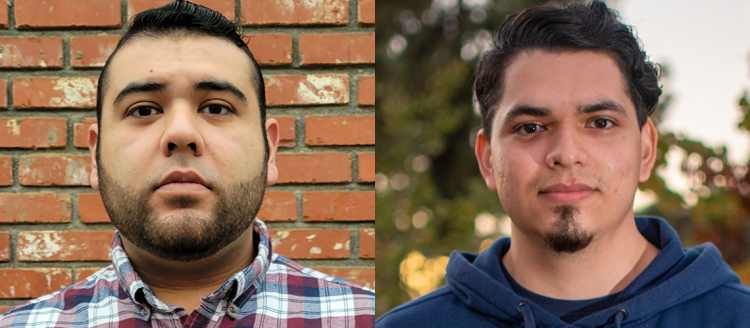
Two of those scholars are first-generation graduate students: Alberto Saldaña Uribe, who studies poetry in the Master of Fine Arts program in creative writing; and Luis Granados Torres, who studies literature in the Master of Arts program in English.
Saldaña Uribe’s scholarship was awarded in honor of emeriti John and Corrinne Hales, and Granados Torres’ scholarship was awarded in memory of emeritus H. Ray McKnight.
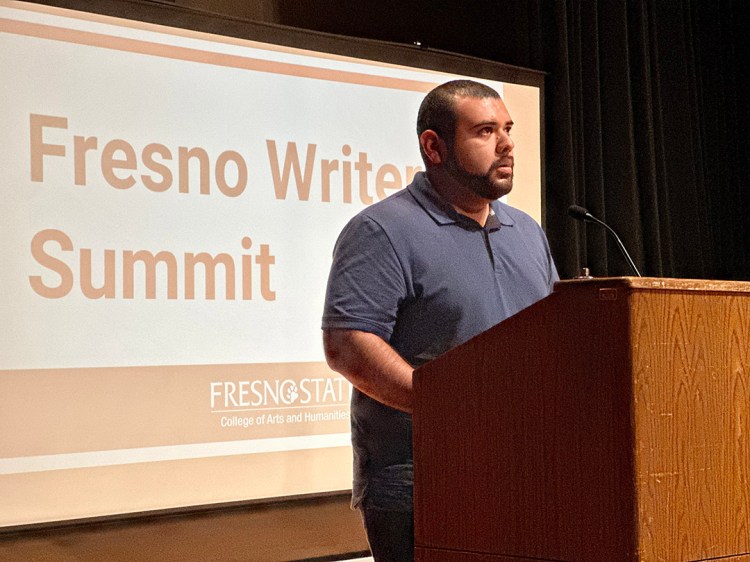
Originally from Wilmington, California, near Long Beach, Alberto Saldaña Uribe’s family moved to western Fresno County, looking for a more affordable place to live. He said he struggled to fit in while attending Caruthers High School, dropping out in the winter of his junior year.
“I’ve always loved the concept of moving away for school,” he said, “but it’s mad expensive, both on the wallet and on the spirit.”
Saldaña Uribe improvised. He passed the California High School Proficiency Exam and started commuting to Fresno City College to take general education classes. At the same time, he also began to help support his grandmother through home hospice care. On the eve of his transfer to Fresno State in fall 2018, he became an uncle. His nephew was born premature at 23 weeks, weighing just 630 grams.
“I applied to Fresno State hoping it’d give me a chance to pursue higher education while staying close to my family,” he said. “Staying close to home was non-negotiable.”
As an undergraduate, Saldaña Uribe earned his bachelor’s degree in biology in 2021, with a minor in Chicano and Latino studies. As a graduate student, he said his first two years studying poetry in the MFA program have felt like a lengthy adjustment period.
“I’ve spent less time refining my voice, mostly just trying to find it,” Saldaña Uribe said. “Not having a traditional English major background has sort of been a blessing. I’m learning about everything for the first time, clean slate, nothing to override.”
Saldaña Uribe said his intention for his thesis manuscript is to generate a love letter to his uncle, a mythical figure in the family who he never met, but who his grandfather always said he looked like. Now an uncle himself, he sees the project as an opportunity to preserve family history while also addressing the cyclical nature of intergenerational trauma, the need for communication across generations, the positives and negatives of masculinity, and the practice of reestablishing faith as your own.
“Family experiences end up getting blended with my own experiences in education, and it can show up on the page as a poem rooted in organic chemistry, biology, physics, or mathematics,” he said. “Mostly, I just want to show the beautiful complexities of my community, and record the stories of people that get overlooked way too often.”
In his poem “Limonene,” published in the Cal State Bakersfield literary journal, The Roadrunner Review, Saldaña Uribe explores his uncle’s decision to become a bracero, navigating familial responsibilities and weighing the consequences of staying or going.
The poet turned to his undergrad notes from organic chemistry for inspiration.
“You need alkaline conditions to promote proton loss, and that loose proton binds to hydroxide, and you get water,” Saldaña Uribe said. “Inevitably, loss of protons into the solution will raise the general pH of it — technically numerically lowered, but raising the concentration of H+. The idea of the alkene being formed through the loss of a proton, and the idea of a family unit becoming more stable with one less mouth to feed, I could play the two concepts off of each other. Acrid longings, sour goodbyes.”
Saldaña Uribe has devoured all the reading in his English courses — “The way the faculty create their book lists,” he said, “you’d swear they were designing some Michelin Star menu” — and he’s in his second year serving as the Senior Associate Poetry Editor for The Normal School magazine, playing a key role in managing a team of readers who brave the slush pile to select the best poems for publication.
Growing up listening to his grandfather tell stories, “conjuring up these vivid movie scenes in the middle of a room, filling every empty silence with that caramel voice of his,” Saldaña Uribe said he has become driven to preserve family stories, writing them down for future generations so they are not lost.
“Writing poetry, learning from incredible professors how to manifest some of Gramps’ magic voice onto the page, this is my way of preserving that legacy, of keeping him and others around, for others to experience,” he said.
Saldaña Uribe said the support he has received from Fresno State — including the 2023 English Department Scholarship, and the 2021 Edward and Alberta Brown Scholarship — has meant everything to him.
“I’m a high school dropout,” he said. “There’s no guaranteed return on investment for someone like me. To earn these scholarships, it’s an absolute honor. I don’t say that lightly. This support from the community is motivation to keep listening and learning, reaffirmation of the decision to preserve oral legacies in ink, and a testament to everyone who chose to gamble on me.”
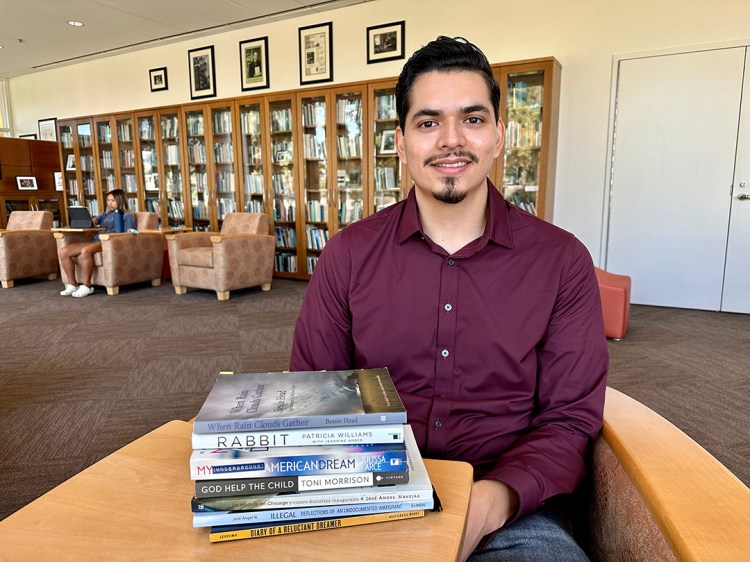
Originally from Pénjamo, Guanajuato in Mexico, Luis Granados Torres came to the United States at age 6 and has lived in Fresno ever since. He describes himself as “a DACAmented Mexican immigrant,” referring to the Deferred Action for Childhood Arrivals program that was created in 2012, to protect eligible young adults who were brought to the U.S. as children from deportation.
As a DACAmented person, Granados Torres said access to a lot of common resources in this country — such as financial aid in higher education — is nonexistent.
“I’ve had to work 30-plus hours a week as a cook in restaurants” while attending school full-time, he said. “I worked two jobs as an undergrad to be able to provide for myself and assist my family.”
After graduating from Roosevelt High School, Granados Torres said he first applied to Fresno State and was accepted, but he wasn’t offered financial aid to attend because he didn’t complete the forms correctly. After taking a year off to work, and to learn more about the application process, he tried again and was admitted with support.
Granados Torres developed an interest in teaching in the third grade. He remembers his favorite teacher at Greenberg Elementary School in southeast Fresno, Ms. Zarate, who he described as “very strict, but also very fun.” She pushed her students to do their best, he said, but she also celebrated academic excellence with rewards like outdoor activities and pizza parties.
That initial feeling of earning rewards for academic achievement stuck with Granados Torres. As an undergraduate, he started out as an English studies major, hoping to become a secondary school teacher. But soon, as he started to feel the complexities of his DACAmented status more acutely in his everyday life, he switched to the English literature major, in hopes of someday becoming a university professor.
“I am driven by my legal status,” Granados Torres said. “As a DACA student, I understand that my level of success is rare. The literature faculty at Fresno State made me want to pursue a doctorate. I want to teach and to conduct research that includes the presence of undocumented communities in society and in literature.”
After earning his bachelor’s degree in English literature from Fresno State in four years — which included three semesters on the Dean’s List and his final semester on the President’s List — Granados Torres began his master’s program. His thesis research focuses on immigrant communities, both undocumented and DACAmented.
“I want to highlight how the undocumented redefine what success is in this nation, based on their limitations from legal status,” Granados Torres said. “I also argue that the undocumented do not need to be overachievers to be accepted. Instead, the undocumented offer another reality estado unidense that does not conform to a capitalist system.”
The scholar is so far focusing on contemporary texts written in English, and contrasting them with early U.S. texts in English such as “Letters from an American Farmer” by J. Hector St. John de Crèvecoeur. His premise: Being born is not what makes one American, rather it is the act of living in the country.
“These texts, and texts about the American experience of Latinx in Spanish, expand the literature that is necessary for scholars, students, and the public to better understand our ‘American’ lives,” Granados Torres said. “And I am joining the de-colonizing movement and incorporating more use of other languages — Spanish, in my case — in everyday life and in classrooms.”
Granados Torres has embraced his time at Fresno State. He met his girlfriend in an undergrad drama class here in 2017, and they’ve been together since 2020. He has presented academic papers at multiple campus conferences, in both the English and history departments, as his research skills continue to grow. And this year, he is teaching first-year writing courses as a Teaching Associate in the English Department.
He also currently serves as president of the Students of English Studies Association (SESA), leading a team of fellow grad students in organizing the group’s annual symposium in December, creating the opportunity for other developing scholars to get their first experiences presenting research at an academic gathering.
Granados Torres said the support he has received from Fresno State — including the 2023 English Department Scholarship, and the 2022 Arts and Humanities Dean’s Council Scholarship — has been invaluable.
He said he felt fortunate last year to land an interview for a full-time job with Fresno County. But as he started to go through the process, Granados Torres was reminded by one of his faculty mentors, Dr. William Arcé, that right now he wants to be a full-time student with a part-time job, not a full-time employee attending school part-time.
“I ended up canceling the interview,” he said. “I had to refocus myself on school, even if it meant earning less at the moment. The support from the community is what allows me to continue pursuing my dreams.”
— — —
To support MFA creative writing students like Alberto, visit the Fresno State Giving website form, select “other,” and write in “John and Corrinne Hales Scholarship,” or call 559.278.1569.
To support M.A. English students like Luis, visit the Fresno State Giving website form, select “other,” and write in “H. Ray McKnight Memorial Scholarship,” or call 559.278.1569.
 The College of Arts and Humanities at Fresno State