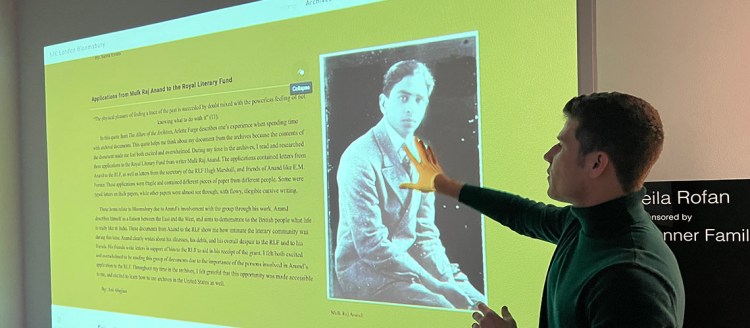
Image: Lucca Lorenzi presents his group presentation of “The Bloomsbury Boys” | Photo by Benjamin Kirk
As the century turned, a group of loosely affiliated collective of English writers, intellectuals, artists, and thinkers in the Bloomsbury district of London actively engaged in discussions on a wide range of topics, including literature, art, politics, and sexuality. Known for intellectual debates and willingness to challenge the prevailing social norms, the group largely rejected Victorian-era conventions. Instead, they embraced individualistic, intellectual and artistic freedom of expression and crafted a new form of modernism which highly influenced the tone of the 20th century. While the small, loosely defined and ever-evolving group largely dissolved by the mid-1940s, its influence and the impact of its members can still be felt today.
A hundred years later, as 2022 drew to a close and the last of the COVID-19 restrictions lifted, 35 Fresno State students from different majors and backgrounds boarded a plane and headed to London for three weeks of culture and scholarship. Two courses were offered, “Bloomsbury Group, Art and Literature,” with Associate Professor Dr. J. Ashley Foster and “London Art and Empire,” with Professor Nick Potter. Students enjoyed an authentic British experience and earned three units of credit as they took in the sights and culture of England.
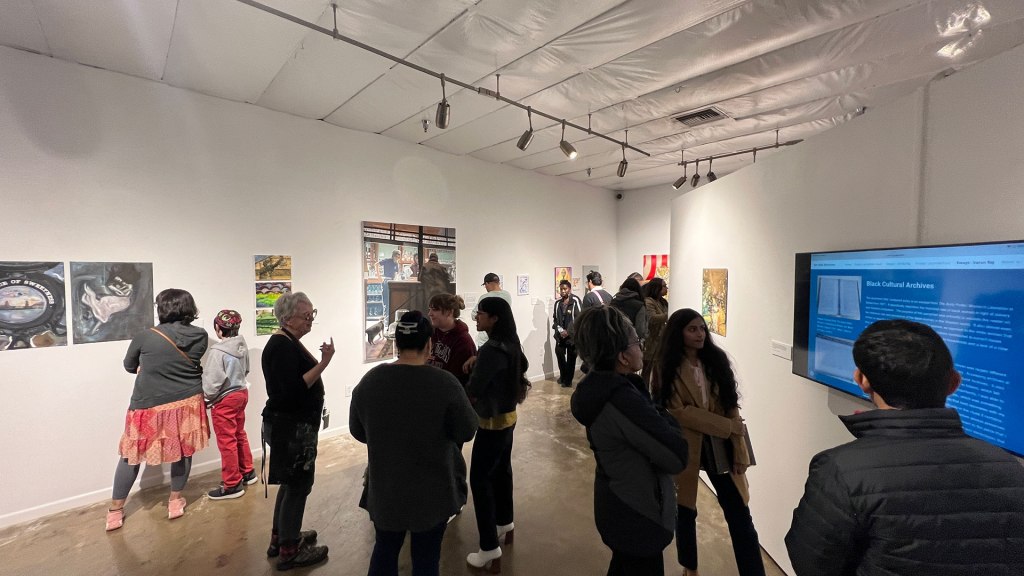
With about three months to reflect on their experience, Fresno State students were present at Fresno State’s M Street Graduate Studios gallery during ArtHop to show off their paintings and projects in a unique exhibition that combined digital humanities with the fine arts.
Dr. Foster’s Bloomsbury Group students excitedly gathered around their TV monitors distributed among Prof. Potter’s art students’ paintings and eagerly scrolled through their projects in a constant mini-presentation to whoever asked. Each project contained a map tracing the walks and locations visited throughout London and the findings of their research in the eight archives they visited.
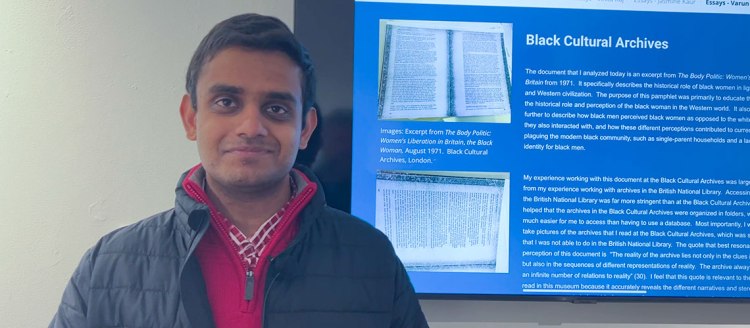
“This helped me grow a lot as a person. The experience I had from this trip is something that I’ll be able to remember for a lifetime,” said Varun Raj, a biology major.
His Bloomsbury project, he said, expanded his ability to understand different methods of research outside of his STEM field. Another student, Raj, who was part of the group “Art and Archives,” showed his work delving into the Black Cultural Archives. Through his research, he learned about the Black community in Britain and how they were impacted by colonialism and imperialism.
“Black people and Asian people were grouped together in terms of the shared experiences they faced,” Raj explained. “That’s very different considering that here, you have a lot of different ethnic groups that face different experiences, whether being immigrants or brought here as laborers. In Britain, you see a lot more of that colonialist influence.”
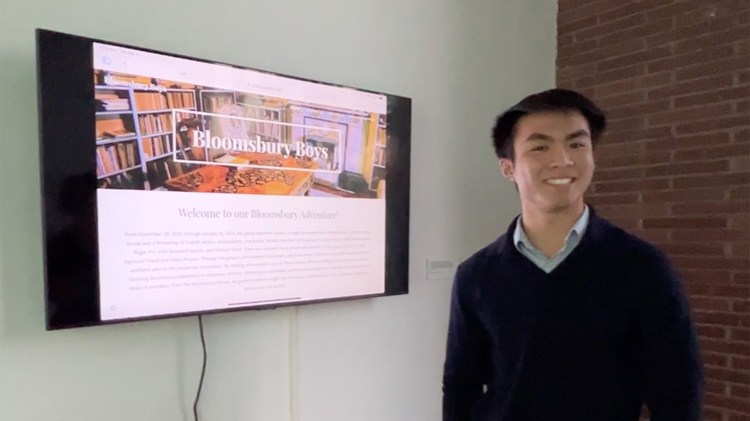
Nicholas Tom, a kinesiology student with the “Bloomsbury Boys” group, took a different approach by examining the letters between married Bloomsbury Group members Leonard Wolfe and Virginia Wolfe.
“Throughout these letters, they are really just expressing their love for each other. You can really see their personality come to life,” said Tom, showing a photo of a century-old letter. “You study these figures as historical figures, but you almost forget that they’re people too. And this one really demonstrates their humanity.”
Tom plans to attend graduate school, and he says the London Program provided an opportunity to travel abroad with his friends while gaining valuable cultural experience.
“With physical therapy and health care in general, there is a move towards cultural competence. In order to have that cultural competence, you need to be exposed to different cultures.”
Tom and Raj, along with 12 other students in the London program, received the Carla Jean and Scot C. Millar Travel Award. Raj and nine other students also received the Dr. Lyman H. Heine and Ardis M. Heine Study Abroad Scholarship to help fund their London experience.
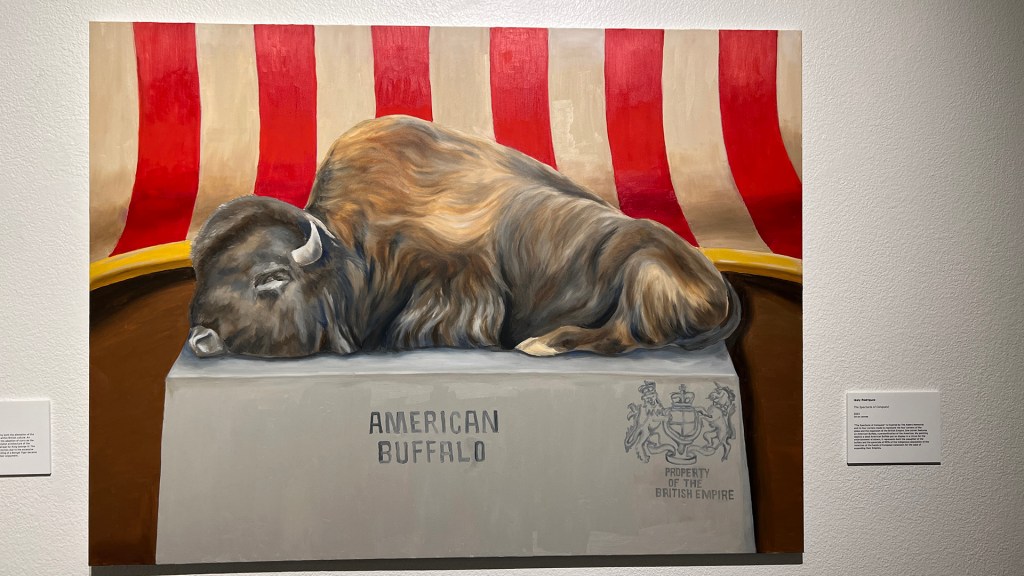
While the humanities students were combing archives around London, the “London Art and Empire” students were visiting the National Gallery, Tate Modern, Tate Britain, the Victoria and Albert Museum and the British Museum and taking in some of the world’s greatest works of art. The students studied how art and culture developed in the British Empire before they arrived, giving them context to the pieces they would experience up close. Wherever they went, they were encouraged to sketch as much as possible, forcing them to focus on details and consider their research.
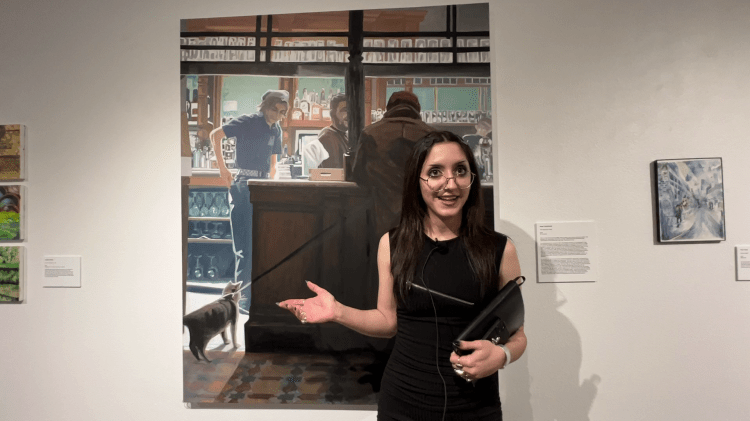
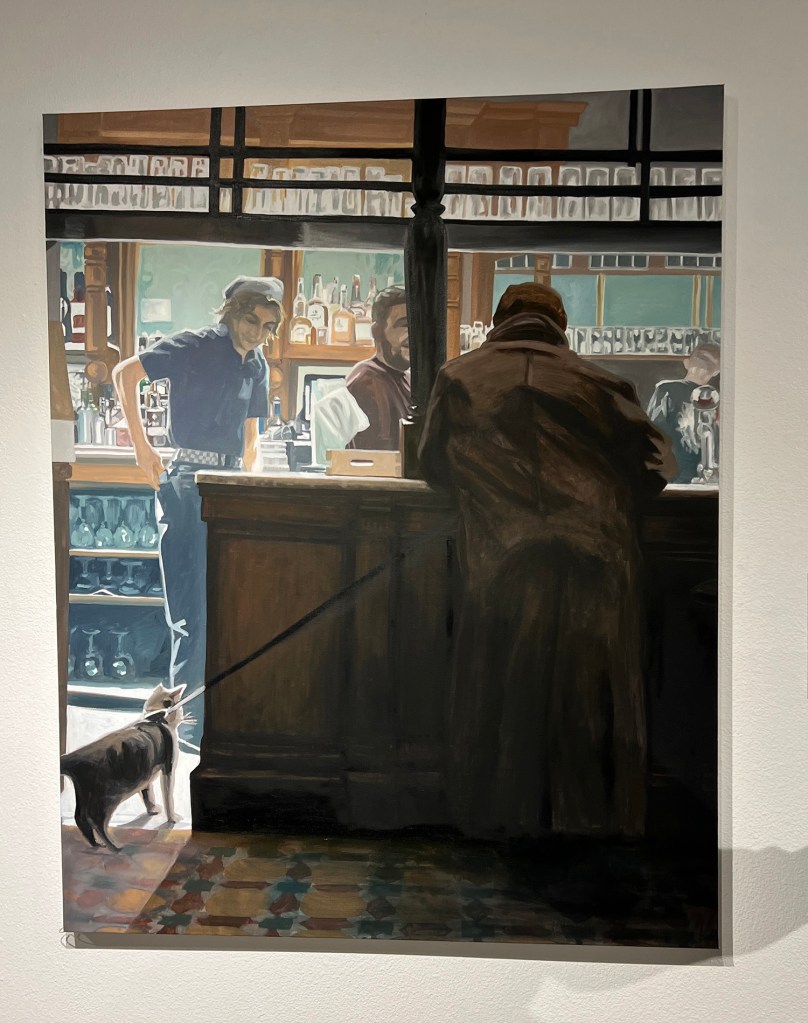
When Angel Lesnikowski, a graduate art student, went to London, it was her first time leaving the United States or even getting on an airplane. Her painting, “The Saracen’s Head,” held a prominent place in the M Street gallery. A realist departure from her usual work exploring death and war from a feminist perspective, the scene depicts The Saracen’s Head pub in London with a special twist.
“This night, being our last night, getting our last bit of London food…watching this man walk in with this cat, and having the experience of the cat on a leash, and the vibes of the pub, it just felt really good,” said Lesnikowski.
Sitting in the pub and processing the last three weeks of research, experience and some of the best works of art in the world’s most prominent museums, she reflected on the art that impacted her the most as she sketched.
“Some of the artwork that I loved the most made you feel like you were looking through a window. The artwork would glow in the background and the foreground would be dark,” Lesnikowski said. “The way the paintings glowed, with the effect of the paint and the darkness framing it like a window, was inspiring to me. This piece, while different from my work, was an experiment. I wanted to experiment with that idea and challenge myself to make a window into a world.”
As a person of Middle Eastern descent, Lesnikowski said she also connected with the name of the pub and its historical meaning as a derogatory slur against Arabs or Muslims during the time of the empire. A “Saracen’s Head” specifically refers to a beheaded Arab whose head was brought back to England as a trophy and displayed in a public gathering place.
“American writer Edward Said’s theory of Orientalism discusses the term Saracen,” said Lesnikowski in her artist’s statement. “He describes how philology and anthropology played a large role in encouraging orientalist views of Islam, and how Arabs and Muslims are depicted as different, fearsome, sinful, and inferior to Europeans by Western writers. So Saracen’s Head, while historical to England and its culture, can be viewed as politically offensive.”
Lesnikowski said the painting draws a line between her experience in the pub, the research done prior to the trip and her own Middle Eastern ancestry.
Returning from London, Lesnikowski said the experience empowered her to see broader opportunities than she previously thought possible. While she is still unsure of her future, for the first time, she is exploring MFA programs beyond California and hopes to become a professional artist or a professor of art.
Lesnikowski credits the Lund Foundation scholarship for helping to fund her trip and encourages students interested in studying abroad to apply for as many scholarships as possible.
If you would like to contribute to scholarships that directly impact student’s lives as they attend the College of Arts and Humanities London Program, contact Director of Development Christine Simon at csimon@csufresno.edu or 559.278.6858.
 The College of Arts and Humanities at Fresno State