Compiled by Jefferson Beavers, communication specialist, Department of English
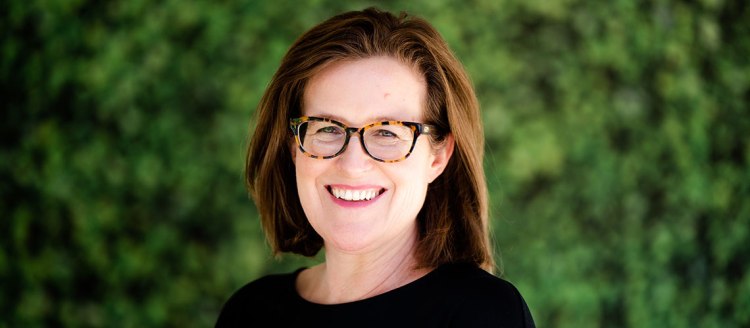
The College of Arts and Humanities welcomes new faculty Michele McConnell to the Department of English. Dr. McConnell specializes in literacy studies, adolescent literacies, critical literacy, and collaborative and participatory writing practices. She has 17 years of experience working with K-12 students across California. Prior to starting her position at Fresno State, Dr. McConnell mentored in-service teachers through their master’s degrees as they completed action research. She is excited to be working with future English teachers in the Central Valley.
What are you most looking forward to teaching at Fresno State?
I can’t wait to meet and work with the students. An interesting aspect of teaching courses in the English Studies program is that I am working with students who are on their way to being my colleagues in the field of education. Because of this, I see my role as a mentor or someone who apprentices them into the profession. I am also excited to get back out into local middle and high schools to observe our students teaching future Bulldogs.
What are your teaching specialties? How did you become involved with those areas?
My specialties include various aspects of literacies and how to teach those literacies to others. I have been fascinated with reading and writing since I was young, but my interest in how we learn to read and write, as well as the systemic barriers that prevent many members of our society from learning to read and write, started when I began teaching in the juvenile court community school (JCCS) system. My experiences in the JCCS in Modesto and Turlock supported a deep dive into critical literacies, culturally responsive pedagogies, and linguistic justice.
How do you hope your background will elevate the English Department’s offerings at Fresno State?
Fresno State has a top-ranking English Department with internationally known faculty and award-winning authors. I am humbled to be working with such faculty. I am not certain that I will help elevate the department. Rather, I can help deepen the department’s understanding of what it means to work with pre-service English educators and the current demands of the teaching job, as I have numerous years of experience teaching K-12, coaching in-service teachers, and teaching in pre-service education programs.
As a new instructor who will be teaching English education, what’s your biggest wish for undergraduates as they learn to explore the possibilities of how to teach young writers and become a good mentor in the classroom?
I hope that I am able to model for soon-to-be English teachers that teaching reading, and more importantly writing, is an act of love. This is not a romantic love or a love that suggests teachers give all of themselves to students all of the time. Rather, I mean a love that is situated in the ability (and willingness) to challenge, support, lift up, and at times struggle with students as they learn what it means to be human through their own writing. I hope the pre-service teachers I work with will learn how to fully be themselves so as to humanize teaching, build meaningful relationships, and implement culturally responsive pedagogies so that students want to read and write.
What are you reading right now?
I finished reading a book of short stories, “How Some Abuelitas Keep Their Chicana Granddaughters Still While Painting Their Portraits in Winter,” by Myriam Gurba. Gurba presents the reader with the reality of being female through cross-border stories steeped in mythology and place. Having spent time in Guadalajara, Mexico, I could immediately place myself in the location of the stories while also being able to identify with the experiences of the women, old and young, across time.
What is a book you think everyone should read, and why?
I find I deeply love books and stories about waiting and wanting. Because of this, I recommend Rebecca Brown’s “The Terrible Girls.” The stories in this book of shorts are allegorical and heavy with symbolism. For example, in one of the stories, a woman gives her arm (literally) to another. I also recommend Ha Jin’s novel, “Waiting.” Jin presents a story in which time, changing politics, laws, and personal desires intersect to examine if what we think we yearn for is worth waiting for.
What’s a fun fact people may not know about you?
I still write letters and postcards on a weekly basis. Saturday mornings, I send a short note to a friend in hopes that when it arrives in the mail, they have a short moment of surprise and joy. In fact, a longer, more intimate form of mail conversation I maintain with a friend, who now lives in Oregon, is shared book annotations. Two weeks ago, a well-loved and annotated copy of TJ Klune’s “In the Lives of Puppets” arrived in my mailbox. At the end of summer, my friend will read a book and annotate as she reads. When she finishes, she mails it to me. I read the book, read her annotations, respond to her thoughts and questions, and then mail it back with a book I have read and annotated.
What are your fall 2023 office hours?
Mondays and Wednesdays from 1 to 4 p.m., and by appointment. I can be reached at michele@mail.fresnostate.edu.
 The College of Arts and Humanities at Fresno State