By Jefferson Beavers, communication specialist, Department of English
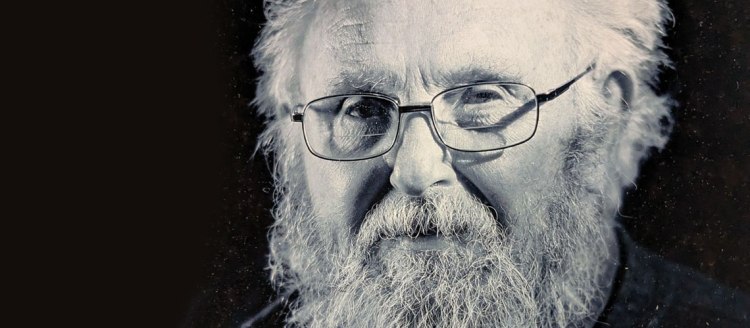
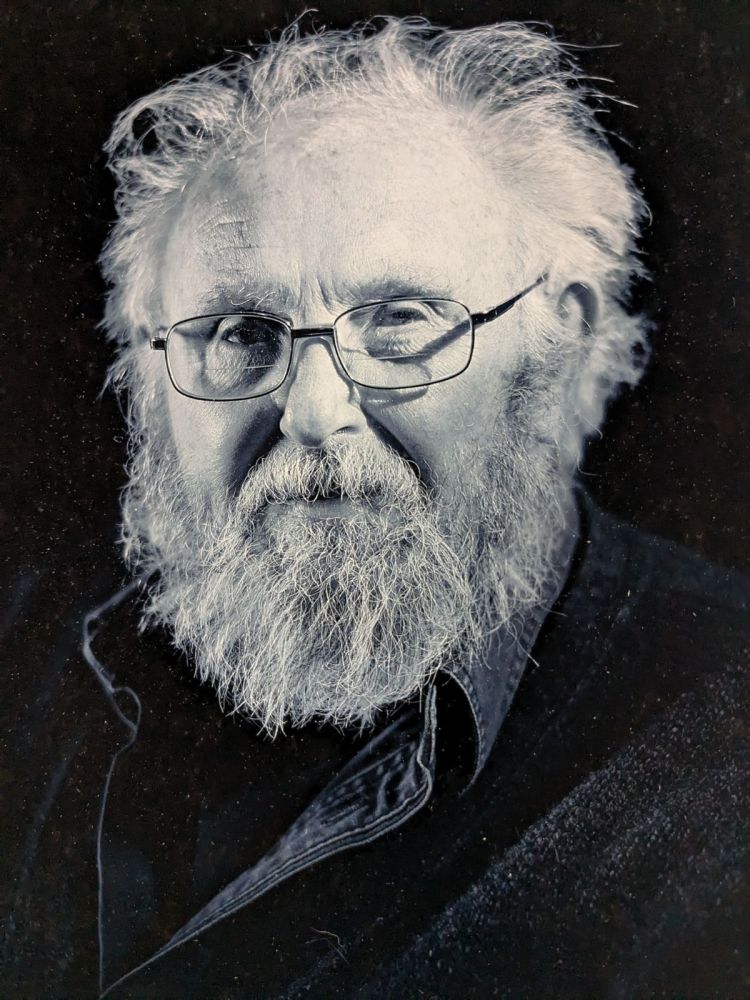
Dr. Eugene Zumwalt, a Fresno State professor emeritus of English, passed away on July 27 in Tollhouse, California. He was 99.
A specialist in Renaissance and medieval literatures, including the works of William Shakespeare and Geoffrey Chaucer, Zumwalt taught courses in literature and nonfiction prose writing at Fresno State from 1959 to 1999. He was a published essayist and poet, and he ran his own printing press.
According to a family obituary published in The Fresno Bee, Zumwalt was a “dedicated and demanding professor,” and he was instrumental in the establishment of the California Faculty Association. Throughout his career, colleagues recognized him as a strong voice for faculty governance, and he served multiple terms on the university’s Academic Senate.
Zumwalt also served as chair of the English Department during the tumultuous early 1970s, during which time he fiercely defended academic freedom and faculty rights, as the campus emerged from anti-war protests and the Civil Rights Movement the decade before.
According to the Sanoian Special Collection of the University Archives, in a 1.75 linear feet report on Campus Unrest, 1965-1979:
“At three o’clock on Friday, December 4, 1970, the tension and distrust of the [President Norman A.] Baxter administration increased exponentially. The dean of the School of Humanities, Ralph Rea, accompanied by campus policemen, marched into the English Department and hand delivered letters of dismissal to Eugene Zumwalt, the department’s chairman, and Roger Chittick, the assistant chairman. The men and the department’s secretaries were then forcibly removed from the office. Another police officer and a maintenance man entered and began sealing the office and its contents, padlocking filing cabinets and barricading the entrance with metal plates. Policemen also guarded the door. Rea continued exerting control of the English Department as he was made the acting chairman, replacing Zumwalt. In an effort to calm what the administration thought was an ideologically radical faculty, Rea altered faculty roles, fired instructors, and changed programs within the department.”
Dr. Honora Chapman, dean of the College of Arts and Humanities, called Zumwalt — who, after a difficult legal fight, was ultimately reinstated to his faculty position — a hero.
“Eugene’s journey took him from flying missions over Europe in World War II to professing with the brilliant humor of Chaucer and Shakespeare that he shared with his lucky Fresno State students for 40 years,” she said.
“Eugene stood up to the ‘clerkes’ and armed officers in his chair’s office and on the rooftop that fateful day in 1970, and he continued to fight the good fight for faculty rights, equal access for all to higher education, and genuine shared governance. His legacy will be the students and faculty who are inspired by his story to stand up to injustice.”
According to Dr. Lisa Weston, a professor of English, Zumwalt as a colleague, “embodied institutional memory and the English Department’s heritage of defending intellectual freedom.” She counts herself blessed to have served with Zumwalt in the Academic Senate, where he “championed the rights and responsibilities of faculty governance.”
Weston said she and many other faculty from all over campus benefited from Zumwalt’s willingness to teach them how to determine which issues were worth fighting for and how to do so fairly and honestly while never failing to speak truth to power. She said her later work both as a department chair and also with the faculty union was deeply impacted by his mentorship.
“For those of us who joined the faculty in the late 1980s and early 1990s, Eugene Zumwalt was an iconic, even mythical figure, even as he was also a welcoming and supportive elder,” Weston said.
Weston said it was her good fortune to also share an academic sub-discipline with Zumwalt as scholars in medieval and early modernist literatures. She appreciated his keen and insightful readings of Shakespeare and Chaucer, and especially the encouragement and support he offered as she developed her own. She said while Zumwalt was, in some ways, a serious and solemn figure, his wit and humor also brought joy to the study of literature and life.
“This was his particular gift as a teacher,” Weston said. “He was a rigorous instructor who held his students to the highest standards of intellectual integrity and demanded no less of himself and his colleagues. His own writing modeled the unflinching honesty he encouraged in his writing students and those whose master’s theses he chaired.”
Nearly 25 years after his retirement, Zumwalt remains a presence in the English Department, Weston said. In 2013, an anonymous community donor made a gift to Fresno State to establish the Eugene Zumwalt English Scholarship in his honor. Since 2015, the department has recognized 35 English majors as Zumwalt Scholars, honoring their academic excellence.
The endowed scholarships in Zumwalt’s name will continue to be awarded annually, in perpetuity.
Eugene Ellsworth Zumwalt was born in 1924 in Portland, Oregon. His father, Howard Zumwalt, worked for American Express selling international travel, and during World War II worked under General Douglas MacArthur, coordinating logistics and food materials for U.S. ships in the Pacific. His mother, Lela Zumwalt, who came from a family of loggers and shingle weavers, was a homemaker.
After graduating from high school, Zumwalt enlisted in the U.S. Army Air Corps. He became a P-38 fighter pilot during World War II, flying 27 missions out of Foggia, Italy.
After the war, Zumwalt earned bachelor’s and master’s degrees in English from the University of Oregon and a Ph.D. in English literature from the University of California, Berkeley. His dissertation was entitled “Divine and Diabolic Irony: The Growth of a Tudor Dramatic Sense.”
Mark Zumwalt, one of Eugene’s four sons, said his father was an inquisitive and curious man of many interests, always busy with various projects. His dad was one of the few people he knew who read and spoke Old English, “which always felt strange.” He remembers finding books he wanted to read in his dad’s home library.
“In order to get that book for myself, he’d make me read it and write an essay,” Mark Zumwalt said, chuckling. “Then he’d correct the essay. It was brutal. I talked him out of using the red ink.”
Mark Zumwalt said his father loved taking the family camping, fishing, and canoeing. Eugene’s uncle Jack was a commercial fisherman on the Columbia River in Skamokawa, Washington, about 20 miles northeast of Astoria, Oregon. The extended Zumwalt family established a decades-long connection to the town, and they continue to hold a family reunion there every summer. Eugene made his last visit to Skamokawa in the summer of 2022.
Eugene was a skilled carpenter and welder. He worked for a time as a welder in the Portland shipyards before college. Mark said his dad “didn’t play around with building,” as he described a recent custom-made contraption Eugene built onto the front of a canoe trailer for hoisting a heavy bicycle off the trailer and onto the ground.
“If there was another piece of steel to be added, he’d add it,” Mark Zumwalt said. “We were in a campground, and some guy was looking at it really close, this god-awful looking crane contraption. He said, ‘I’m an engineer, and I’ve never seen anything like it.’”
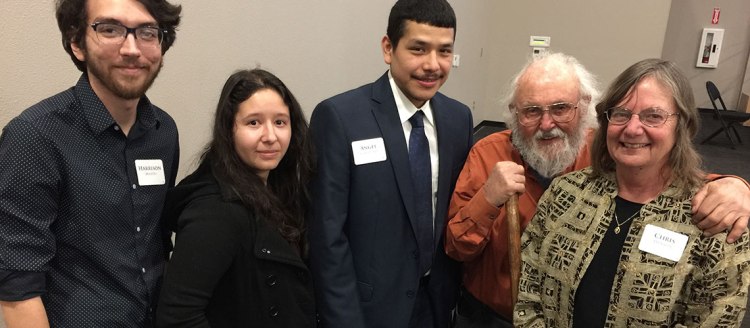
In addition to welding and building, Zumwalt enjoyed running his own small printing press, said his wife, Dr. Chris Henson, a professor emerita of English from Fresno State. They married in 1997 and built a house together in Tollhouse in northern Fresno County.
Zumwalt and his English Department colleague Dr. Roger Chittick published books together under the imprint Zumwalt Press for a number of years. This included an early poetry chapbook by Jon Veinberg, an early book of artworks by Charles Gaines, and a stamp collector’s catalog compiled by Chittick and his wife, Joy, among other books.
Later, Zumwalt and Henson re-started the press as Scrub Jay Press. They printed books by Fresno poets David R.C. Good and Don Parkey; an anthology of Yosemite poets; a memoir by a Chowchilla man who was a pilot with the Flying Tigers; a collection by a Louisiana photographer of Works Progress Administration archival images alongside newer images documenting the evolution of the landscapes; and other books.
Five of Zumwalt’s original poems were anthologized in the 1987 collection “Piecework: 19 Fresno Poets,” edited by Jon Veinberg and Ernesto Trejo. These included the poem “Talking to the Grass,” which included the following section addressed to his father:
Was it after you broke your nose for the third time
Have you learned something about the world?
How to roll with the punches and laugh,
How to take it and give it back of its own,
How to book the best stateroom
On the cruiseship of old earth
And sail it to any port of call
Without compass, for on the round globe
All points are the same, after all,
All noses can be equally broken.
Henson, who taught in Fresno State’s English Department from 1984-2020, said her husband was fierce and courageous. His dedication to standing up for academic freedom and faculty rights — from before her time at the university — came at a great personal cost to Zumwalt, his first wife, Norma, and their sons.
“Some people stopped talking to him, turned away from him,” Henson said. “He always said it was really hard on him and Norma. They felt like outcasts. But he refused to back down, and he continued to speak out throughout his teaching career.”
Despite Zumwalt’s many interests and accomplishments, Henson said it would be impossible for the tumult and trauma of the early 1970s on campus not to define his life and work.
The developments of the times have been well documented, perhaps most notably in the 1979 Kenneth A. Seib book “The Slow Death of Fresno State,” and in Zumwalt’s 2011 appearance on the KVPR “Valley Writers Read” program to read his essay about the English Department lockout, “Beyond the Roses.”
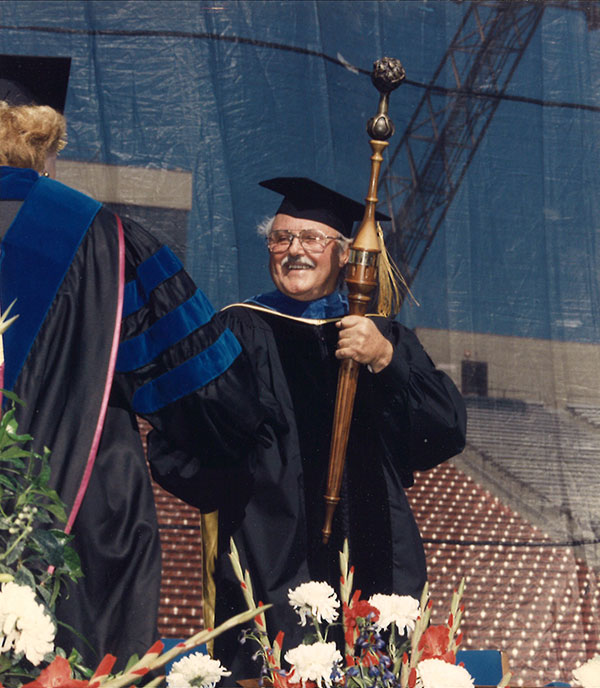
At the end of his long teaching career, according to Henson, Zumwalt earned an accomplishment that he felt was symbolically important: He served three times as grand marshal and mace-bearer at the university’s commencement. This ceremonial honor — and with it, the role of leading the faculty delegation at graduation — goes to the longest-tenured faculty on campus.
In a previously published 2019 interview, Henson said Zumwalt’s bearing of the ceremonial mace meant that “he had outlasted all the administrators who, in the late 1960s and early 1970s, had reacted so strongly against those who worked to diversify the student body and the faculty, who spoke out against the Vietnam War, who insisted that no one should be fired without due process. He outlasted those who seized the English Department office and who deposed him as department chair. He completed a 40-year career as a dedicated teacher and scholar and also as someone who truly believed in faculty governance.”
Eugene Zumwalt is survived by wife, Chris Henson; son Mark Zumwalt and daughter-in-law Joan Zumwalt; son Kurt Zumwalt and daughter-in-law Teri Zumwalt; son Karl Zumwalt; daughter-in-law Diane Zumwalt; six grandchildren; and six great grandchildren. He was preceded in death by his parents; his first wife, Norma Zumwalt; and his son Gary Zumwalt.
Memorial services will be private. In lieu of flowers, the family requests memorial gifts be made to the Fresno State English Department. Checks can be made to the Fresno State Foundation, with “Eugene Zumwalt Scholarship” in the memo, and mailed to 2380 E. Keats Ave., MB99, Fresno, CA 93740. For questions about donations, call 559.278.6858.
 The College of Arts and Humanities at Fresno State
Thank you for sharing this memory of Dr. Zumwalt. I was a freshman at Fresno State in 1970 when all of the turmoil was going on about the campus. It made for an interesting start to my education. I’ve always believed that those professors helped me have a liberal view of the world and to stand against the patriarchy.
LikeLiked by 1 person
He was such an inspiration in my humble life. I attribute my success as a teacher directly to Dr. Zumwalt. He will live on in so many ways. God bless you, Dr. Zumwalt.
LikeLiked by 1 person
I am so grateful I had Eugene Zumwalt as a professor while in the CSUF MFA program. I loved his humor and warmth, his editing was uncanny and he inspired me as a teacher!
LikeLike